

Boreal Forest - An Introduction
Getting To Know The Life Of The Northern Forest 
Portions adapted from - Ecoregions of Saskatchewan CD-ROM
The taiga, boreal forest, northern coniferous forest, whichever name you choose, is one of the world's greatest ecosystems. The boreal forest comprises at lease one-third of Canada. In North America it forms a vast, continuous band from Newfoundland and Labrador westward to the Rocky Mountains and Alaska, roughly 6.5 million square km (2.5 million square miles). It is a patchwork quilt of life that sweeps around the northern hemisphere, encircling the globe like an immense green cloak. The boreal forest is bordered on the north by the lichen woodland grading into tundra and by various communities of vegetation to the south.
"Put quite simply, the taiga or boreal forest is the set of forest ecosystems that can survive in the North....across much of North America only eight tree species can be found...The sub-arctic climate is so harsh that it induces primarily a conifer forest". J. David Henry
At the same time as it has few species of trees, the boreal forest as a landscape, is a diverse mosaic of forests of various ages and composition.
The word 'boreal' comes from the Greek name for the Goddess of the North Wind. So, the 'boreal forest' is literally the 'northern forest'. 'Taiga' is another name frequently applied to this forest. It stems from a Russian word.
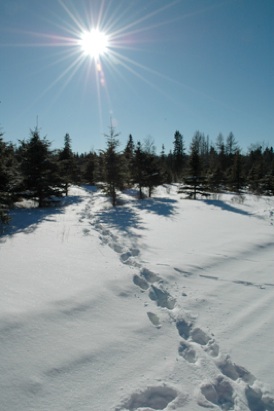
The forest mosaic been designed by stresses; the stress of long, snowy winters; the stress of a short growing season; the stress of repeated, naturally occurring forest fires.
Silhouetted spires of spruce, pine and fir are familiar sights against lingering summer sunsets. It is the realm of the moose and black fly, woodland caribou, wolf, raven and loon amongst thousands of others.
For as much as this ecosystem is forest, it is also water. Rivers, deep lakes and spreading bogs dominate the Shield bedrock and marshes and quiet streams do so on the glacial till.
The plants, animals and other organisms that live in the boreal forest are adapted to these conditions. Characteristics such as hibernation, long distance migration, energy conserving behaviour, unique physical features and 'evergreeness' are essential for many boreal inhabitants. It has also been home to people for thousands of years. Many cultures have adapted and thrived in this environment.
"When one tugs at a single thing in Nature they find it attached to the rest of the world.", John Muir
... for "Nature is not only more complex than we presently know but also quite possibly more complex than we can know". (Robyn Eckersly paraphrased from Aldo Leopold)
An ecosystem is the basic unit of nature which includes air, water, soil and all living things each interacting with the other. An ecosystem can be as small as a drop of water or as big as an ocean. Size is not as important as how things function together. For every action in the ecosystem there is a reaction and every animal and plant is somehow connected to the others.
The term ecology is derived from okologie, a word coined by the German zoologist Ernst Haeckel to mean " the relationship of the animal to its organic as well as its inorganic environment." The origin of the word is the Greek oikos, meaning "household", "home" or "place to live". Thus ecology deals with the organism and its place to live, that is environment..."
Sometimes, the boreal forest is referred to as a biome. The Earth's biomes are classified by their major types of vegetation. There are grasslands, temperate broad-leaf forests, tropical rainforests, warm and cold deserts, tundra, savannah and others, including the marine biomes. 

"Fostering an ecological perspective begins with a more integrated view of ecosystems. Ecological land classification is a process of classifying and delineating ecologically distinctive areas of land, so we can better understand their similarities and relationships."Ecoregions of Saskatchewan CD-ROM
The classification system currently in use employs a heirarchy of areas from the largest to the smallest, namely Ecozones, Ecoregions and Ecodistricts. When you visit with Sundogs Sled Excursions you'll experience the Emma Lake Upland, Waskesiu Upland and Montreal Lake Plain Ecodistricts all in the Mid-boreal Upland Ecoregion of the Boreal Plain Ecozone.
We hope you'll learn much more about the boreal forest, our home, and yours too while you visit. Along with your experiences here, may you come to better appreciate, understand, cherish and protect this part of our wonderful world.
  1. BulletBoreal Forest Intro

  1. BulletBoreal Climate and Energy

  1. BulletBoreal Trees

  1. BulletBoreal Forest

  1. BulletLocation


Copyright (c) 2009 Sundogs Sled Excursions

Sundogs Sled Excursions

Box 212  Waskesiu  

Saskatchewan CANADA S0J 2Y0

306.960.1654